
Where the tiger walks
In our fortnightly podcast, Annu Jalais on tigers, equity, and what the Sundarbans actually needs

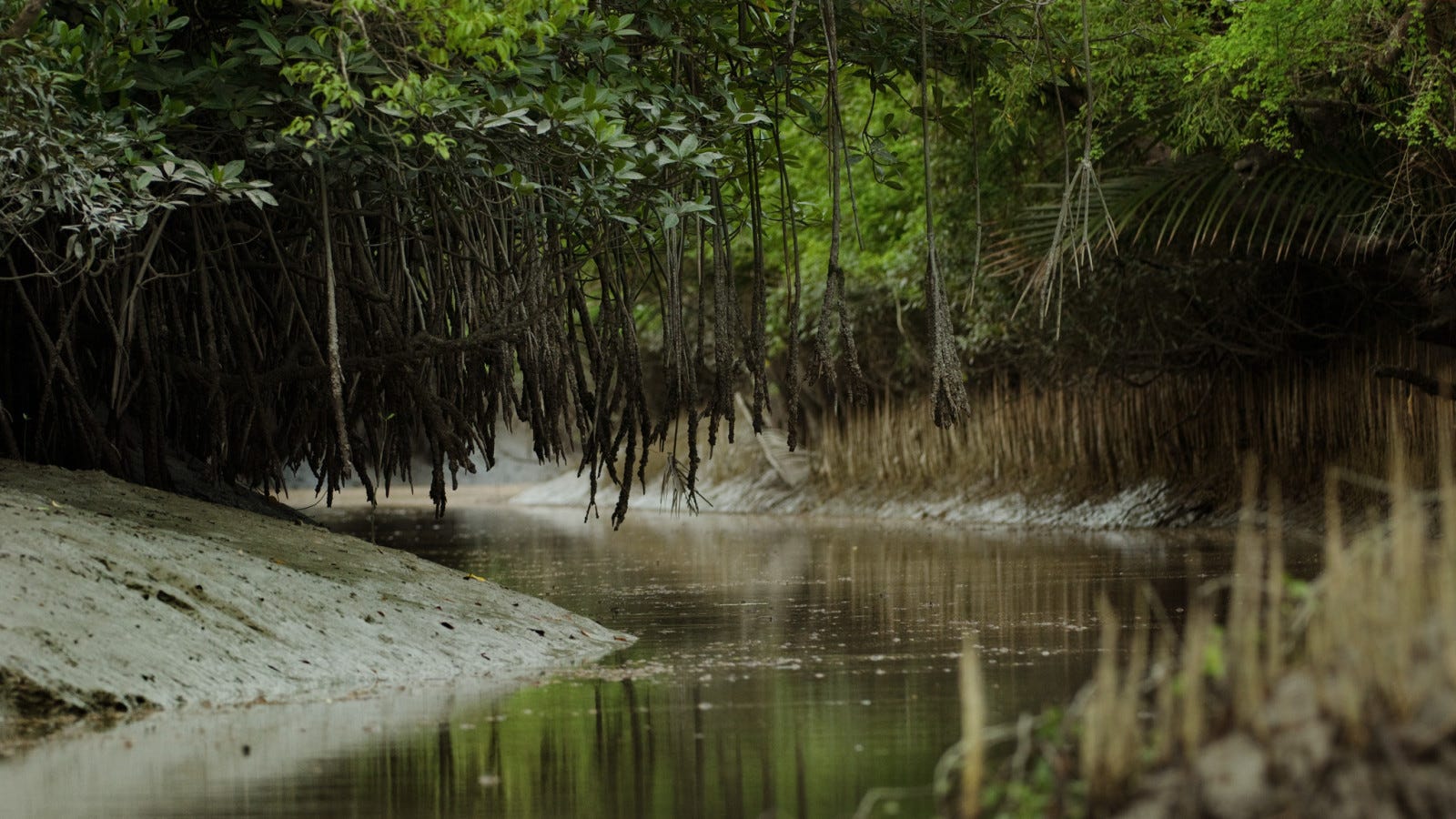
I went to the Sundarbans once, years ago, while reporting on something else entirely. Half a day, maybe less. I remember thinking: one of the largest mangrove forests in the world, wow, cool — and then, in the manner of the generalist reporter I was then, moving on to the next thing.
It wasn’t until much later that the place began to build itself properly in my mind. In 2012, I met Arati Kumar-Rao (her Instagram is a must-follow), and over the years that followed I began participating in her environmental work — sometimes in person, more often virtually, through her calls from the field, through the images and videos she brought back, through the stories she wrote. The Sundarbans is a place Arati has returned to over and over again, so there were a lot of those calls, a lot of stories and visuals. And thus, without quite realising it, I had been accumulating a sense of the place — its tidal rhythms, its particular dangers, its people — entirely through her eyes.
When I sat down to prep for this conversation with Annu Jalais, I felt a strange familiarity. Like I knew the Sundarbans well. It took me a moment to register that my knowledge was almost entirely secondhand. The conversation with Jalais added another layer to a mosaic I hadn’t realised I was building.
There is a figure in the Sundarbans known as the tiger charmer. He walks at the front of every forest expedition. He carries no special weapon. What he carries, instead, is a fatalistic acceptance that if a tiger comes, he will be taken first, so that the others might survive. It is not resignation. It is a role, a covenant, a form of moral architecture built by a community that has lived alongside one of the world’s most dangerous predators for three hundred years.
This is where Annu Jalais begins, and it is a long way from where most conversations about the Sundarbans start.
Jalais is an environmental social anthropologist who has spent nearly three decades returning to the Sundarbans. She first went at eight years old. She came back for her PhD fieldwork in 1999, drawn partly by a small, telling detail: the forest department was distributing tiger-deterrent masks to villagers, but the scientists wouldn’t wear them. That asymmetry between who bears the risk, and who gets to study it from a safe distance has animated her work ever since.
In the latest episode of From The Marginlands, Arati and I spent close to two hours in conversation with her. What follows is an inadequate summary of a rich conversation (the episode is linked below, and I’d encourage you to listen to the whole thing).
The tigers of the Sundarbans are genuinely unlike tigers elsewhere. They climb boats. They track humans through the tidal channels. The standard explanations — that the salt water prevents territorial marking, that human blood offers something the brackish diet doesn’t — may or may not be sufficient. What Jalais finds more interesting is the society that has built itself around this fact. The forest workers enter on ten-day cycles, and are bound by strict codes of conduct: no greed, no quarrels, no claiming more than your fair share. A five-person boat crew that divides its catch six ways, with the sixth share belonging to the boat itself. A system, in other words, that builds equity into its foundations, not as ideology but as survival.
That equity is under pressure. Education, Jalais observes, has become a new hierarchy: the degree holder stops physical labour entirely. But the exception is instructive: educated women continue to work regardless, because the hierarchies that education disrupts for men don’t extend to women in the same way. And yet, something else is shifting. Young women from the islands are choosing city work over village marriage. The money is better, it belongs to them rather than their in-laws, and the smartphone has opened up a world of connection that the island no longer monopolises. Even women in their sixties are receiving marriage proposals through Facebook.
The Sundarbans, thus, is not a place frozen in time. Nor is it simply a victim of climate change, or at least, not in the ways the funding narratives tend to suggest. Jalais is sharp on this. Climate change has become a buzzword that NGOs and government agencies use to secure grants while the actual problems — crumbling infrastructure, absent hospitals, teachers hired from outside who don’t live in the villages, corruption that bleeds development funds dry — go unaddressed. The proposal to relocate four million people is, she argues, not just impractical but based on a fundamental failure to look at who actually lives there and how. The organic out-migration is already happening. Young people are moving to cities. What the Sundarbans needs is not evacuation but investment in local hiring, in functional governance, in treating its residents as citizens rather than problems.
What stays with me most, though, is something Jalais said near the end of the conversation: that the Sundarbans has kept her grounded and humane in ways that academic life alone couldn’t have. That her deepest debt is to the people who taught her what coexistence actually looks like when it isn’t a concept but a daily negotiation with mortality. You hear it in the way she talks: with precision, yes, but also with a quality that is harder to name. Something like respect that has been earned over time, through proximity, through showing up. Here is the full episode:
PS: Read Arati’s excellent reporting (enhanced by her signature photography) here: Scroll down to the section titled “Estuaries: The Endangered Sundarbans”
As always, do send in comments, thoughts, suggestions for future episodes.