
The Active Voice
On Dharmendra Pradhan's resignation, and the fiction it finally broke

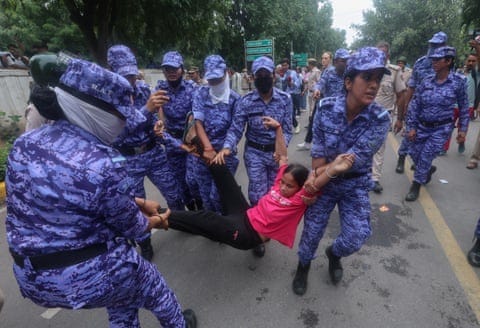
DHARMENDRA PRADHAN resigned on Saturday. In the calculus of this government, that sentence should not be possible. Defence Minister Rajnath Singh said as much once, in so many words, smirking as though he found the whole idea of accountability risible:
For twelve years, the Modi government has operated on a carefully cultivated premise: that it cannot be questioned. Modi set the template by refusing to attend a single press conference.
If you cannot ask questions, you cannot fix responsibility.
This core operating principle has conferred on the BJP the aura of immovability. If public anger rises, the government will ride it out. If streets fill with protestors, they will be emptied by force. The state machinery — the police, pliant media channels, the investigative agencies, the batteries of trolls — will work in harness to grind any challenge into fatigue, and then into forgetting.
The government does not have to perform this ability every time — it only needs the people to believe the ability exists. Power is most efficient when it no longer has to be exercised, when citizens have been conditioned to rein in their own expectations before the state has to refuse them.
That wall has now been breached. A senior minister has been made to resign from office because public anger made his continuation untenable. The young did not stop there: they remained until the government negotiated; until it agreed that cases against peaceful protesters would be quashed, that compensation would be paid to the families of aspirants whose deaths the movement linked to the examination disaster, and that a charter of examination reforms would be taken up. Only then did the Cockroach Janta Party call off its agitation.
The Modi government’s promises are invariably written on water, and therefore in the coming days its actions will need to be monitored. A promise made to get people to empty a street, to vacate a protest site, does not necessarily mean the promise will be kept once the street has emptied and the site has been vacated. But the central fact is beyond dispute: the state was, for once, made to answer to the citizen.
The manner of Pradhan’s exit reminds us that this government has not, will not, accept the principle of responsibility even when it performs it. In his letter, he did not say that under his watch the examination system had betrayed the people who depended on it, never mind expressing regret. Rather, he framed his departure as a sacrifice made to spare the young “legal complexities” and to prevent “anti-national forces” from capturing their movement.
His Cabinet colleagues and other party leaders flooded the airwaves with eulogistic comment: Amit Shah, Adityanath, Ashwini Vaishnav, Rajnath Singh, Piyush Goyal, Kiren Rijiju… Read their statements, and you’d think these are testimonials in support of Pradhan’s claim for immediate elevation to sainthood.
Even in retreat, the BJP’s reflex holds. Those statements are meant to recast the resignation as protection, to reframe the aggrieved as gullible children in danger of manipulation, to recast the government, which sent armed police against them, as their thoughtful, compassionate guardian.
Here is the thing, though: a euphemism can disguise an action but it cannot make the action unhappen. For all the spin, Dharmendra Pradhan did not wake up on Saturday seized by an urgent desire to protect the young. He resigned because the young would not go home.
That is the wall breached, beyond the power of words to paper over the crack.
xxx
THE MODI government’s theory of democracy is that the citizen’s power begins and ends at the ballot box. You vote, you confer a mandate on Modi, and then you fall silent till the next election comes around — that, in Modi’s worldview, is the role of the citizen. If you raise your voice in the interval between one election and the next, you are not a citizen with a grievance, asking for redress. Instead, you are anti-national, an urban Naxal, a parasite, a cockroach, a foreign-funded nuisance to be suppressed by all available means.
In Modi’s world, the vote we cast to chose a government is in fact another choice entirely: we are choosing obedience. We are not conferring a mandate so much as inflicting on ourselves a five-year gag order.
For those five years, Modi and his cohort govern in passive voice. Papers were leaked. Lapses are regretted. Strict action will be taken. Committees have been formed. Investigations have been ordered. But there is never agency, never an answer to the basic question: Who is responsible? Responsibility is never allowed to travel upwards to the door of the ministerial office, because to allow that is to concede the forbidden principle: that power is answerable to the people on days other than polling day.
That is why this resignation matters way beyond the identity of the man who resigned.
xxx
THERE HAVE, of course, been victories against this government. To forget them is to reinforce the carefully cultivated myth of invincibility.
Take the farmers’ protest. The three farm laws, which the government bulldozed through Parliament in 2020 with its customary mix of haste and hauteur, were repealed in November 2021 after a year of extraordinary resistance. The farmers, through sheer obduracy and a refusal to back down, forced the government to abandon a policy it had declared was both necessary and beneficial.
That victory was not cosmetic — it was a genuine defeat for the state, a genuine victory for organized public action.
But again, look at the choreography of that retreat, which was necessitated by the imminence of crucial state elections but tricked out in the garb of magnanimity. Thus, this framing from Modi:
“I apologise to you, my countrymen, that despite my government’s good intentions, there may have been some lack in our Tapasya (penance) that we could not convince some of our farmer brothers of the intentions of these laws which were as pure as the light from a lamp”
Look closer, and you will notice that while the laws were scrapped and the policy was reversed, responsibility was not allowed to attach itself to a person. The government and its media arm rapidly plastered over the breach, and the aura of individual untouchability survived.
Take the uprising of 2019 and 2020.
In January 2020, writing while the country was in ferment, I called it a million mutinies tied together by humanity and hope. I wrote of workers, farmers, students, teachers and professionals uniting in resistance, their protest sparked by a million different aggravations — economic distress, unemployment, unpaid wages, the Citizenship (Amendment) Act and the looming threat of the NRC…
I thought, then, that the breadth of the citizen’s disaffections was the strength of the protest. Six years on, I still think so, but I have also come to understand that the selfsame breadth was also its strategic weakness.
The protests, which had the CAA/NRC as its proximate trigger, became over time an estuary into which every accumulated grievance against the government flowed. This allowed people who had been isolated by the state to discover one another and come together in a fellowship of the aggrieved. And it restored the flag and the Constitution to the people from whom a majoritarian project had tried to confiscate both.
But therein lay the crux of the problem: a movement that contains every imaginable grievance cannot be satisfied by any single concession. There is no single act which proves that the government has heard, nor any one refusal that can be seen as proof of the government’s bad faith.
With the perspective that time and distance brings, I realize that sentimentalizing the protest, as I did here, does it a disservice because it glosses over the fact that protesters were vilified as traitors, arrested, beaten and prosecuted. Ministers supplied slogans — such as the infamous Goli maaro saalon ko — that by any yardstick was incitement to violence. And in response, Delhi burned.
And then, in March 2020, the pandemic did what the government’s stormtroopers could not do — it emptied public space. Shaheen Bagh and the hundreds of sit-ins it inspired were cleared under the imperative of lockdown. Covid, thus, supplied the state with the ending it had not been able to produce by other means. A mass movement was interrupted; that interruption was gradually reframed as a defeat; that defeat was folded into the myth of Modi’s invincibility.
The government has lived off that myth ever since.
xxx
THIS latest movement began when contempt was met with a call to action.
After the Chief Justice of India was reported as comparing unemployed young people entering media, activism and public-interest work to cockroaches and parasites — a comment he later said had been misreported — Abhijeet Dipke responded with a what-if that sparked a movement:

This is a generation raised on a national sermon about merit. Study, they are constantly told. Compete. Work hard. Do not ask for privilege. Sit for the exam. Earn your advancement.
Millions of families built their lives around that promise. Parents sold land, took loans, and went without in order to fund their children’s education. Young people moved to coaching towns, lived in cramped rooms, learned to treat sleep as an indulgence.
Then the papers leaked. Questions were traded, access was sold and years of hard work was nullified by someone’s money and someone else’s connections. The state that lectured the young about merit failed to protect the integrity of the examination room.
Dipke’s tweet found ready resonance in a generation that had been pushed to the brink. And when they took to the streets, the response from the establishment was predictable: the protestors are backed by “foreign forces”, they are anti-nationals, part of a global conspiracy,…
At the protest, one of these “anti-national forces” introduced himself. His name is Manish Kumar. He is from Gaya district in Bihar. He works ten hours a day for Blinkit, studies after his shift, and helps keep his household running. On July 12, he said, he sat an examination for the Indian Army and missed qualifying by one mark. Listen to him:
Manish is not a NEET aspirant, and that is what makes his presence at the protest even more revealing. His presence, his story, tells you that the leak was merely the spark — the combustible material was everywhere. Manish speaks for the vast republic of the never-will-haves: the young who do everything the country asks of them and still find the door to advancement barred to them.
His accusation is devastating because it is so simple: If a seat can be bought, then what precisely is the student being examined for? Is he being rated for his knowledge, or on his ability to purchase exemption from knowledge?
“We have not come here to fight,” Manish said. “We are students. We have come to fight with the strength of our education.”
There is the answer to the conspiracy theory. The “foreign hand” is a poor boy from Bihar working 10 hours in the gig economy, providing for his family, studying at night, all for a chance to serve the country in the uniform of its army.
The “foreign conspiracy” insinuation seeks to erase Manish and the hundreds of thousands like him who thronged Jantar Mantar. It asks us to ignore the grieving citizen and seek the phantom force supposedly instigating him. It is the oldest trick in the authoritarian playbook: when the question cannot be answered, use ad hominem to disqualify the questioner.
It is a nuanced ploy. Officially, the government discounts foreign funding; on the ground, its mouthpieces continue to peddle that tired trope.
xxx
THE government and its defenders describe what happened in Delhi as a breakdown of order, as an attempt to destablize the nation.
The serial leaks of exam papers did not destabilize the nation. Seats are sold, but the republic did not tremble. Families could mortgage land, children could break under the weight of a corrupted process, but the republic remains stable even as the state announces yet another inquiry. Children, 21 of them, took their own lives, but the republic was not shamed.
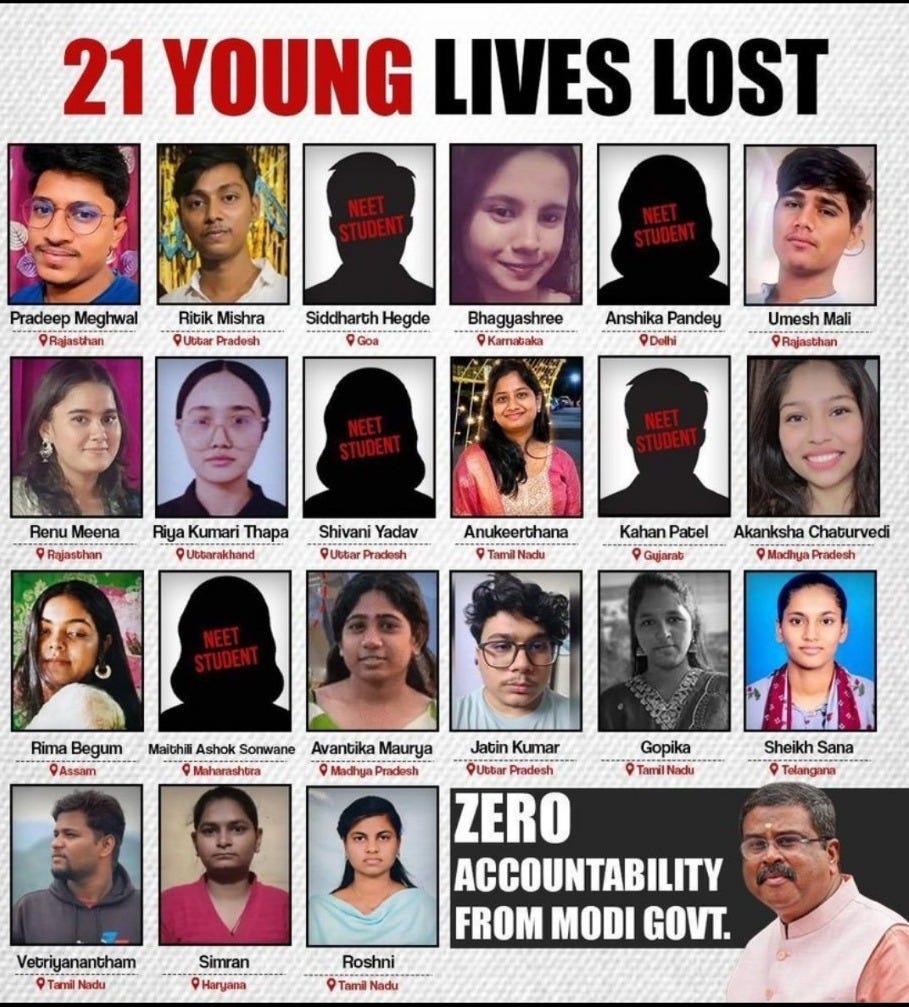
Disorder, according to this government, begins only when those with grievances assemble in such large numbers that it is impossible to look away.
Tens of thousands came into central Delhi. The police met them with barricades, batons and tear gas; there were also medically corroborated reports of pellet injuries, which the police have denied. Metro stations were shut down, the internet was suspended. When citizens moved towards the building that houses their elected representatives, the state treated it as though democracy itself were under attack.
The state exercised its might without understanding that a government secure in its legitimacy does not need to make citizens disappear. When it shut down metro stations and communications, stopped food and water from reaching the protestors, and sent armed police against the citizens, the government was displaying fear — the very real fear that if a public realizes it has leverage, the wall that insulates the governing class from accountability for its actions will be breached beyond repair.
Speaking with an eloquence rarely seen in Parliament, a young protestor — Mohammed Irfan of Delhi, to give him his name — provided the citizen’s view of democracy:
“In a democracy there should be no arrogance, only dialogue — and the doors of dialogue must be open from both sides.”
That seems so obvious as to not need words -- but given what this government has reduced the republic to, it sounds almost insurrectionary.
Irfan reminded his listeners that Sonam Wangchuk was not asking for a Rajya Sabha seat or a cabinet post. On behalf of students everywhere, Wangchuk was asking for something that, in an ideal world, should not need asking: he was asking for a broken education system to be repaired, for responsibility to be fixed, for the concerned minister to resign.
Irfan voiced the one principle that this government has spent more than a decade trying to erase:
“Disagreement in a democracy is not a crime.”
It is not a crime to seek justice. It is not a crime to ask why an exam was sold. It is not a crime to demand that an office-bearer accepts responsibility.
The real crime, which Irfan had the moral vocabulary to name, is to take education, in which millions of young people repose their aspirations, and turn it into merchandise.
If the state does not recognize that, if it uses the full might of office to crush questioning, then, as this young lady said with enviable eloquence (and without needing a teleprompter), “This is an authoritarian playground masquerading as a democracy.”
xxx
IT IS tempting to turn the story of this protest into a Bollywood-style storyline: a contemptuous comment provokes an irreverent joke which then is reinterpreted as a call to action; that call brings people out onto the street and, despite the best efforts of institutional power, it fells a minister.
But it is worth studying the real reason why this protest succeeded. The students had many demands: they wanted Pradhan to resign, yes, but they also sought compensation for the families whose young had been driven to suicide; they sought protection from the brutal excesses of the state machinery and the withdrawal of cases the state had filed against them; they demanded accountability for police violence; they insisted on the repair of a broken examination system.
The protestors clearly understood that one resignation, without accompanying reforms, means nothing. But what is worth noting is that the protestors made one central demand the litmus test of the government’s willingness to right its wrongs.
Examine what happened because the protestors foregrounded Pradhan’s resignation as their basic demand. As the protests gained momentum, the government fell back on its standard playbook: it announced “measures”; it said it would set up fast-track courts; it promised action against unnamed culprits.
That is a classic ploy of this government — whenever the question of accountability is raised, it tries to deflect, to bargain, to announce anodyne measures that distract from the real demand.
It is a tried and tested playbook, but it didn’t work this time because the protestors refused to budge from their central demand: the minister had to go.
The citizen was telling the state that accountability mattered; that responsibility could not be bargained down through a series of sops, nor deflected by midnight Instagram reels.
On the surface, it was a demand that cost the government little. Ministers are expendable; to jettison one if it means being able to protect the architecture of centralized power is not a big sacrifice.
Except, the removal cost more than a mere change of personnel. A system meticulously crafted to diffuse blame — the PM at one point said that preventing leaks was a national responsibility — was finally forced to locate blame in a named individual. And in doing so, it was forced to concede what it has spent twelve years avoiding: the principle of accountability.
You could argue, as some have, that the victory is Pyrrhic. That the system is not broken, it is merely that a fuse tripped.
But what that framing ignores is that a fuse blows only when a current passes through it -- a current the machinery is not designed to withstand. That current of sustained protests flowed through the state machinery, and in doing so proved that unrelenting public pressure can impose a cost.
The lesson is not that every movement must become single-issue, center a single demand. It is that while a movement can carry many grievances, it needs to give itself a non-negotiable core demand that serves as an unequivocal test of the government’s sincerity.
That is what the Cockroach Janta Party did. It gathered the entirety of a generation’s injuries and drove one demand through them like a nail. Having done that, it then refused every official attempt to divert, to defuse the movement through sops.
What this central demand did was to shift the government’s operating principle: When credit is being distributed, there is always a name, a person, to accept that credit, but when things go wrong and blame arrives, it is always impersonal; there is never a name to pin that blame to.
xxx
THIS is not an end but a beginning. The promises made must now be monitored and audited in full public view. Have the cases actually been quashed, or have they been put in the deep-freeze until the collective attention is distracted, when they can be revived? Which families receive compensation, on what basis will they be chosen, and when? Is it only deaths that merit compensation? How about injuries, some grievous? What exactly does the five-point charter require? Who implements it? By what deadline? What changes are made to exam security, procurement, testing agencies and grievance redress? Do these changes translate into actual reform? Where does independent oversight find a place within the revamped system? And above all, who answers if the next paper leaks?
Given all this, it is fair to say that the resignation is in and of itself insufficient — but that is not to say it is insignificant.
We have fallen into the habit of greeting every victory by listing what it did not accomplish. In doing that, we forget that no street movement has ever repaired a broken republic in one move.
The real test, therefore, is not to ask what has been left undone, but to question whether the protests managed to alter how power conducts itself.
I would argue that it did.
The protests compelled a minister to resign. They compelled the government to talk to, not at, them. They obtained commitments on paper. And above all, they made us remember that the interval between elections is not — should not be — politically sterile.
That last achievement may well be the biggest win of the CJP protests.
This government has tried to create a citizen who is merely a voter appearing periodically, if he is allowed to appear at all, to press a button and then go home. The protests rejected that framing and reimagined the voter as a citizen who remains after the elections are done; a citizen who monitors, questions, assembles and, when it becomes necessary, takes to the street to demand that governance be twinned with accountability.
In the government’s view, the voter’s mandate is something to be banked at election time and drawn on for the next five years on the basis of a one-time authorization. But what Manish Kumar knows is that while a mandate does permit a party to govern, it does not release it from the obligation to answer to the governed. When he said that politicians come asking for votes like beggars and, after winning, imagine themselves to be emperors, he was compressing the pathology of our age into one memorable sentence.
In an age where elected representatives behave like royalty and citizens are conditioned to accept the role of supplicants, Manish came to Delhi to tell the minister that the chair he occupies comes with conditions attached. That is the citizen restoring the active voice to our conversation with the state.
Over the past twelve years, this government has ruled in passive voice: steps will be taken, lapses are regrettable, mistakes were made, deaths have occurred.
Bad things happen, but there is never any agency.
Accountability is the inverse. Someone had authority. Someone failed. Therefore, someone must answer.
By naming that “someone”, the students finally forced agency into a sentence that was carefully designed to contain none.
It is likely that once the dust settles, the government will succeed in quietly restoring much of the old arrangement. After all, power has money, institutions, police, tame media, and infinite patience. Against that, a sustained public movement needs bodies, and bodies will inevitably tire; lives that have been put on hold will need to be resumed.
Maybe that is why there can be no final victories in a democracy — because power never loses its appetite, not completely.
But this is still a victory. GenZ succeeded in retaking the republic from those who mistook temporary office for permanent ownership. And above all, they changed our idea of what is possible.
We look at the machinery arrayed against us and conclude that resistance is futile. On Saturday, GenZ presented us with evidence to the contrary.
The protestors showed us that power is not omnipotent. That it can be made to answer. That occupation of high office can be made conditional on performance.
And they showed us a new, typically GenZ, way of doing it. They did this by seizing the pejoratives that power used to diminish them, and using those same insults to mock power, to laugh at the powerful, and above all to return insult as indictment.
The protest has been called off, the site vacated. Manish Kumar has gone back home to his ten-hour shifts after which he will study, because he still lives in a country where a single mark can separate employment from precarity.
Nothing about his life has become any easier because a minister resigned.
But the political world around him has changed. For twelve years, the state has tried to write the citizen out of the sentence. This week, the young put the subject back in.
Irfan does not even have a house, his father and he live amid some broken walls in folding cots and a fan, thanks to a kind person. A few blocks away live his mother and sisters, hopefully in a room with a lockable door. He cannot write but has made full use of this reading ability, gained in an anganwadi. There are many others like him. Almost 80 years after independence, which again BJP and its parents and sympathisers actually sabotaged, Irfan and lakhs like him are still not free. Only the skin color of the rulers has changed. The poor, the lower castes, the dalits, the minorities, the tribals, the hill people, the disabled, even many women... have almost zero access to anything that this government has been squawking about. All this is such a criminal waste of potential and hope. If even half of them had achieved what the elites and those in power have in the last 75 years, India would have been close to, if not ahead of, China. (At least previous governments never said they had achieved everything.) Whatever is happening is long overdue. This is just a spark; when the fire starts, these fossils in the government will be left with only ashes.
Such beauty, such poetry, above all, such truth in Irfan's words.