
Permission to dissent, sir?
India guarantees its citizens the right to protest. *Terms and conditions apply.


INDIA’s Constitution guarantees the right to protest. But you have to apply for police permission first.
Too often these days, the response to your application is in the language of settled fact: Permission for the protest has not been granted. There will be a line or two of boilerplate attached: “internal security”, “hardship to citizens”, and suchlike formulations.
The media duly runs with the police formula: The organizers applied, the police gave the application due consideration, permission was refused.
And with that, your protest has become “unauthorized”. If you decide to go ahead notwithstanding, you are breaking the law and any action the police takes against you — batons, water cannons, pellet guns and, in Siwan, AK-47s — is presented as the inevitable consequence of your law-breaking.
Pause on that thought for a moment.
A group of citizens has a grievance against the state. Before they can express that grievance in public, they must first approach the state, name their organizers, disclose the time and place, estimate the numbers, and ask, in effect: Sir, may we please protest against you?
The state may say no. Or it may say yes, but only between certain hours, at a place of its choosing, with a capped number of people, and without a march, a loudspeaker, a stage or a tent. That is, without any of the means by which a protest makes itself visible.
More recently, the state has discovered one more wrinkle. If it does give you permission to protest at a particular venue, it creates a physical box, a cage to pen you into. Reports coming in from Jantar Mantar as I write this talk of immovable barricades being erected at the venue in anticipation of renewed GenZ protests.
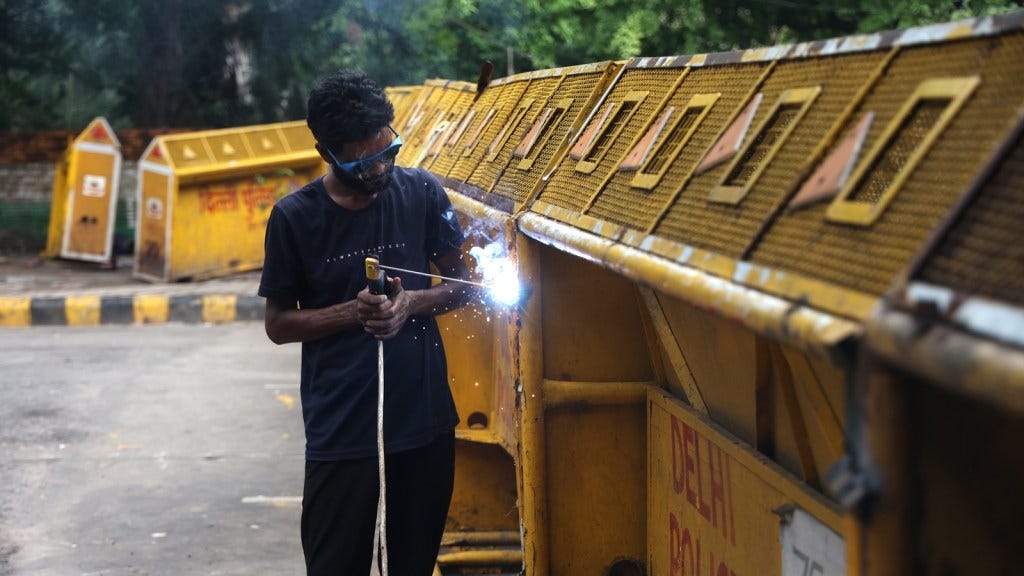
In other words, you have the right to dissent from the state provided you do so on the state’s terms, at a place of the state’s choosing, during only those hours that suit the state.
Somehow, we have managed to turn a fundamental right into an application form.
xxx
THE Constitution does not explicitly use the term “protest”. However, it guarantees the freedoms from which protest necessarily follows: speech and expression under Article 19(1)(a), and the right to assemble peaceably and without arms under Article 19(1)(b). The Supreme Court has repeatedly held that when read together, these two freedoms protect the right to demonstrate peacefully.
Why then should the exercise of the right have to depend on executive permission?
I asked a senior police official this question. (Disclosure: he is related to me, though somewhat distantly). His response, paraphrased, was: a group of you guys can’t suddenly decide to take over the streets without notice, because that can cause problems. There are plans to be made. Traffic will need to be diverted, routes will have to be kept open for emergency vehicles, the police will have to ensure that the participants are protected, and prevent rival groups from colliding. That is why you need to take prior permission, in order to enable us to plan for all this.
There is an element of sophistry here. The situation my relative outlined is me, the citizen, telling authority that I intend to exercise a constitutional right, so please make all the arrangements you think fit.
But intimation is not a synonym for permission. In the case of intimation, I own the right; in the case of permission, the state owns what should belong to me.
The officer pointed out that small, spontaneous gatherings sometimes occur, without prior permission. For instance, a group of disgruntled employees of, say, a restaurant decide to sit in dharna outside the establishment’s gate with no permission sought or obtained.
Fair enough, but that is in fact the crux: the state is ok with protests as long as they are small and localized. Let a protest become large enough or politically visible enough to matter, though, and the permit regime reflexively kicks in.
You still have the right, for what it is worth, but its exercise is by appointment only.
xxx
HOW did we get here? Predictably, the trail leads back to the days of the Raj.
The Police Act was introduced in 1861. In 1895, a licensing form was introduced in Section 30 that empowered senior officers to regulate assemblies and processions, to prescribe routes and timings and, in cases where a gathering was deemed likely to cause a breach of the peace, require that its organizers apply for a licence.
Those two dates are significant. The uprising of 1857 — the Sepoy Mutiny or the First War of Indian Independence, depending on which text you read — caught the British off guard and in its aftermath, it was decided to reorganize the police force. The 1861 Act was a direct result, and the provision for licensing was designed to provide a means to control the Raj’s subjects.
Notably, though, even in the high noon of the Raj, the restriction was tied to a quantifiable risk of disorder, not enshrined as an automatic precondition for every assembly.
The British left, but the machinery remained. Independent India inherited the colonial police along with its governing statutes and its repressive instincts. India also inherited Section 144 of the Code of Criminal Procedure — now rechristened, with more or less similar powers, as Section 163 of the Bharatiya Nagarik Suraksha Sanhita — which allows a magistrate to issue prohibitory orders in cases where “immediate prevention or speedy remedy” is required.
On paper, the powers are to be exercised in case of emergency. In practice, the exercise of those powers has become a matter of routine governance.
A lawyer I know tells me that the Supreme Court has repeatedly warned of this. In Acharya Jagdishwaranand Avadhuta v Commissioner of Police, the apex court ruled that the successive imposition of Section 144 orders, where the order is renewed as soon as it lapses, could amount to abuse of power; that a provision intended to cope with a temporary emergency was never intended to become “semi-permanent in character”.
Decades later, in Mazdoor Kisan Shakti Sangathan v Union of India, the Court found that repetitive Section 144 orders in Central Delhi had created “a situation of perpetuity”, in effect banning public meetings rather than merely regulating them.
In sum, orders meant to address a clear and present danger are renewed until a temporary prohibition becomes a permanent condition. Over time, we have come to accept this as a norm. We kept the right to protest, but we weighted it down with a manual for suppressing it.
xxx
OUR apex court has, over time, indulged in sleight of law. It has on the one hand repeatedly affirmed the right to protest while, on the other, it has built a box within which the right may be exercised. And over time, it has made the box smaller and smaller.
In Himat Lal K. Shah v Commissioner of Police, Ahmedabad, the Supreme Court said that the state could not close down every street and open space to public meetings. It held that such meetings are an integral part of the tradition of national life, and that there is a constitutional difference between reasonable regulation and arbitrary exclusion.
The apex court did not say that the prior-permission system was unconstitutional. It merely struck down one particular rule on the grounds that it offered no guidance on when permission could be refused.
The problem is that catch-all phrases such as “law and order”, “security inputs” and “possible inconvenience” can be construed as the guidance the apex court asked for and become, in practice, formulas that can justify any refusal.
This problem became visible in 2017 when the National Green Tribunal banned protests at Jantar Mantar on the grounds of noise and pollution. The consequent Mazdoor Kisan Shakti Sangathan case resulted in the apex court overturning that ban and reaffirming peaceful protest as a fundamental right. But having done that, it prescribed permissions, numbers, timings, routes, and designated areas. In other words, while it removed the blanket ban, it allowed the architecture of the permit system to remain in place.
Then came Shaheen Bagh. The specific issue before the court was that an arterial public road had remained blocked for a prolonged period, causing quantifiable inconvenience to commuters. But rather than confine itself to the question of such indefinite occupation of a public thoroughfare, the court’s judgment expanded its scope and ruled that demonstrations expressing dissent must take place in “designated places”.
Lo, one prolonged road blockade became the excuse for a more general doctrine of containment.
This is how a fundamental right shrinks without ever being formally abolished — one restriction at a time, each restriction arriving with a plausible justification: traffic, security, residents’ sleep, noise, numbers...
In isolation, all of these seem reasonable. But in the aggregate, they have resulted in creating a democracy from which the public has been zoned out.
xxx
WHILE the courts did their bit to limit the right to protest, geography attacked that right from another direction. Delhi’s map tells this story.
For years, the Boat Club lawns functioned as the theatre of Indian democracy. The venue’s proximity to Parliament and to the offices of government meant that power could not avoid seeing the protest, hearing the voices of the protestors, and being inconvenienced by it all.
In October 1988, the Boat Club lawns was the venue for the farmers’ agitation led by Mahendra Singh Tikait of the Bharatiya Kisan Union. An estimated five lakh farmers occupied the lawns for the better part of a week, their occupation stretching from India Gate to Vijay Chowk.


Tikait’s mass mobilisation prepared the ground for the restrictions that followed. In 1993, citing security concerns in the aftermath of the Babri Masjid demolition, the Congress government banned protests at Boat Club and shifted the capital’s principal protest venue to Jantar Mantar. (And yes, Congress governments have been equally guilty of choking down public protests.)
These moves were cloaked in administrative reasoning (Large gatherings at Boat Club paralyze the government’s functioning), but the cumulative result was to move dissent farther away from the seat of power.
More recently, the government found that the new address did not fully insulate it from the noise of dissent. In 2017, the NGT again stepped in to ban protests at Jantar Mantar. The Supreme Court lifted the ban in July 2018, but the underlying principle remained intact: the state would decide where the citizen could make a stand.
In the wake of the recent GenZ protest, BJP-adjacent voices have renewed the demand to ban protests at Jantar Mantar. Security risk, they say. Too close to Parliament. Here is former IPS officer Kiran Bedi making the case for shifting protests to Ramlila Maidan, either unaware of or uncaring that the apex court had deemed the maidan to be an unsuitable venue:
Jantar Mantar is too close to Parliament, she says, invoking the usual “security risk”. But that is the thing: the choice of venue is integral, not incidental, to protest.
A demonstration outside Parliament makes a point that the same gathering in a distant field in the outskirts of the national capital cannot make. Workers protesting outside their employer’s office are saying something that they cannot say with equal force if they are assigned a park several km distant. Students with a grievance protesting outside their institution are directing their protest directly to those who have failed them.
Protests work only when they are addressed directly to power. A protest shifted out of power’s line of sight, confined within barricades, and dispersed as soon as authority feels inconvenienced may, in the public record, still count as a protest — but in actual fact, it has been neutered.
There is another problem with “designated venues”. The Delhi police is currently scrutinizing a backlog of applications to protest at Jantar Mantar. “Senior officers said requests for permission to protest have been pouring in almost daily over the past month, but none was approved while the CJP agitation was underway,” the report says. So now grievance has to stand in line, and if one group’s grievance is urgent, it cannot be voiced in time because the designated site has a ‘houseful’ board.
The state argues that today, citizens have television and social media and therefore need not occupy politically significant physical space. In 2018, in Mazdoor Kisan Shakti Sangathan v Union of India, when protestors argued that dissent once moved away from proximity to the seat of power loses its force, the apex court in its judgment (Paragraph 64) suggested that print, television and apps such as WhatsApp, Twitter, and Instagram could carry “a concerned voice” to the “right quarters”.
Except that in practice, as we are now seeing in the case of the GenZ protests, the government and its enforcement arm, the police, repeatedly issues takedown notices to social media platforms; television media is increasingly under the indirect control of the government and blacks out all visuals of the protests. In any case, the government can turn a deaf ear to digital noise or blow smoke at it with an ease it cannot achieve when the protestor is right under its nose.
Physical space matters. Numbers matter. The anti-NEET protest first kicked off on 6 June at Jantar Mantar, but was largely ignored by the government and media alike. It gained traction only three weeks later when, around 28 June, Sonam Wangchuk began an indefinite hunger strike. And the protest reached its tipping point only on 20 July when thousands of protestors arrived for a planned march to Parliament.
For 45 days from 6 June, there was no dearth of WhatsApp messages and Instagram reels; what shifted the balance was the outsize physical turnout on 20 July. And that is precisely why the apex court’s suggestion to use social media defeats the purpose of protest.
By way of aside, note that in the above judgment the apex court did not say that digital media can completely replace physical protest. In the same paragraph #64, it acknowledged that Ramlila Maidan was an inadequate venue, and directed that limited demonstrations should be allowed to continue at Jantar Mantar.
What is significant though is the narrower proposition enshrined in that judgment: that protestors could not insist on one specific location.
Take the two points together. “Limited demonstration” is open to official interpretation, and officialdom will invariably read it down. This couples with the point that the protestor cannot insist on, say, occupying Jantar Mantar, to further shrink the space available to the aggrieved and the disenfranchised.
A social-media post is not the constitutional equivalent of a public assembly. People gather not merely to transmit information but to make their numbers visible, and to turn a private grievance into a public fact.
Power understands this. That is why a million Instagram reels can leave it unmoved, but ten thousand people gathering in its line of sight forces it to take notice.
xxx
A PROTEST is by definition disruptive. That is its function.
A march will interrupt traffic. A strike will halt production. A sit-in will interrupt the normal use of a place. Protesters resort to these methods because — when — ordinary channels fail to produce a response. If governments read and responded to memoranda, our streets would be much quieter.
I am not arguing that every degree of disruption must be tolerated. Back then, my sympathies were with Shaheen Bagh, but I am not blind to the fact that the complete blockade of the arterial Noida-Kalindi Kunj-Mathura highway effectively cut off all traffic between central Delhi and one of the capital’s key suburbs. Citizens using that highway for their daily commerce have their rights too.
But balancing rights is not the same as treating inconvenience as an excuse to flat out say no to a protest. The job of the police and the administration is to find a way to balance the rights of the protestors with those of the rest of the population through negotiation.
There is, besides, a central irony in the police denying permission because a gathering “may create a law-and-order problem”. Under that formula, the protesting citizen becomes responsible not only for their own conduct but for every danger the state can imagine. And inevitably, the more politically inconvenient the grievance, the greater the risk the police will imagine and the greater the imagined risk, the easier it becomes to refuse permission.
To say I have the freedom to protest provided no one is disturbed is like saying I have the freedom to go on strike provided classes are not halted or production is not stopped.
The right to protest exists and is protected. If the state wants to restrict it, or to deny permission altogether, it cannot do that with a one-line order. “Security concerns” won’t cut it. What is the specific threat? On what evidence? Why will a narrower restriction not be sufficient? Who will review the refusal, and how quickly?
“Law and order” and “security concerns” cannot become incantations to make a constitutionally guaranteed right disappear.
What I am driving at is that there is no single law or judgment that erases my right to protest. Rather, that right has been trammelled in cumulative fashion: a colonial-era license bled into independent India, an emergency provision became an instrument of routine policing, “designated spaces” divided cities into protest and non-protest zones, courts routinely acknowledged the right to protest while simultaneously enlarging the government’s ability to determine where and how it can be exercised, and news media began treating the denial of police permission as proof of illegality.
But the real change has been cultural. We have come to accept, over time, that protest is an aberration that must justify itself.
The relationship between the state and the protestor needs to be turned the right way up. Citizens should only have to notify the state, not seek its blessing. The administration should be able to propose limited changes necessary to protect safety, access and competing rights, but not deny permission in toto. If it wishes to impose restrictions, it has to identify the danger, place its reasoning on record, and show why less stringent measures are not adequate. And its decision must be open to timely independent review.
That is the system that a democracy genuinely committed to Article 19 should build.
Before protesting against the state, the citizen should not have to ask: Sir, may I protest, please?
Huge gathering of people, disruption to traffic, nuisance to general public - how come these do not apply when it is a Ganapathi Bappa Mourya or a Navratri 'celebration'. The cumulative hours I had lost in Thane is enough to ready Ulyssess, twice!
जब सड़कें सूनी हो जाती हैं, तो संसद आवारा हो जाती है" - Dr Ram Manohar Lohia
https://x.com/_YogendraYadav/status/1447898450452893698