
India's digital dream, hacked...
...and what makes it great journalism

Earlier this morning, I posted a twitter thread about a Bloomberg Businessweek piece that had just won the Pulitzer Prize.
The piece — “India’s Digital Dream, Hacked,” by Natalie Obiko Pearson and Suparna Sharma — is about the epidemic of “digital arrest” scams sweeping India. In my thread, I made the point that the structural choices were the argument, that the form enacted the meaning. An excellent writer from whom I continue to learn much, and who also happens to be a very good friend, messaged to say the thread should be a blogpost. So here we are.
But I want to start somewhere else. I want to start with a singing policeman.
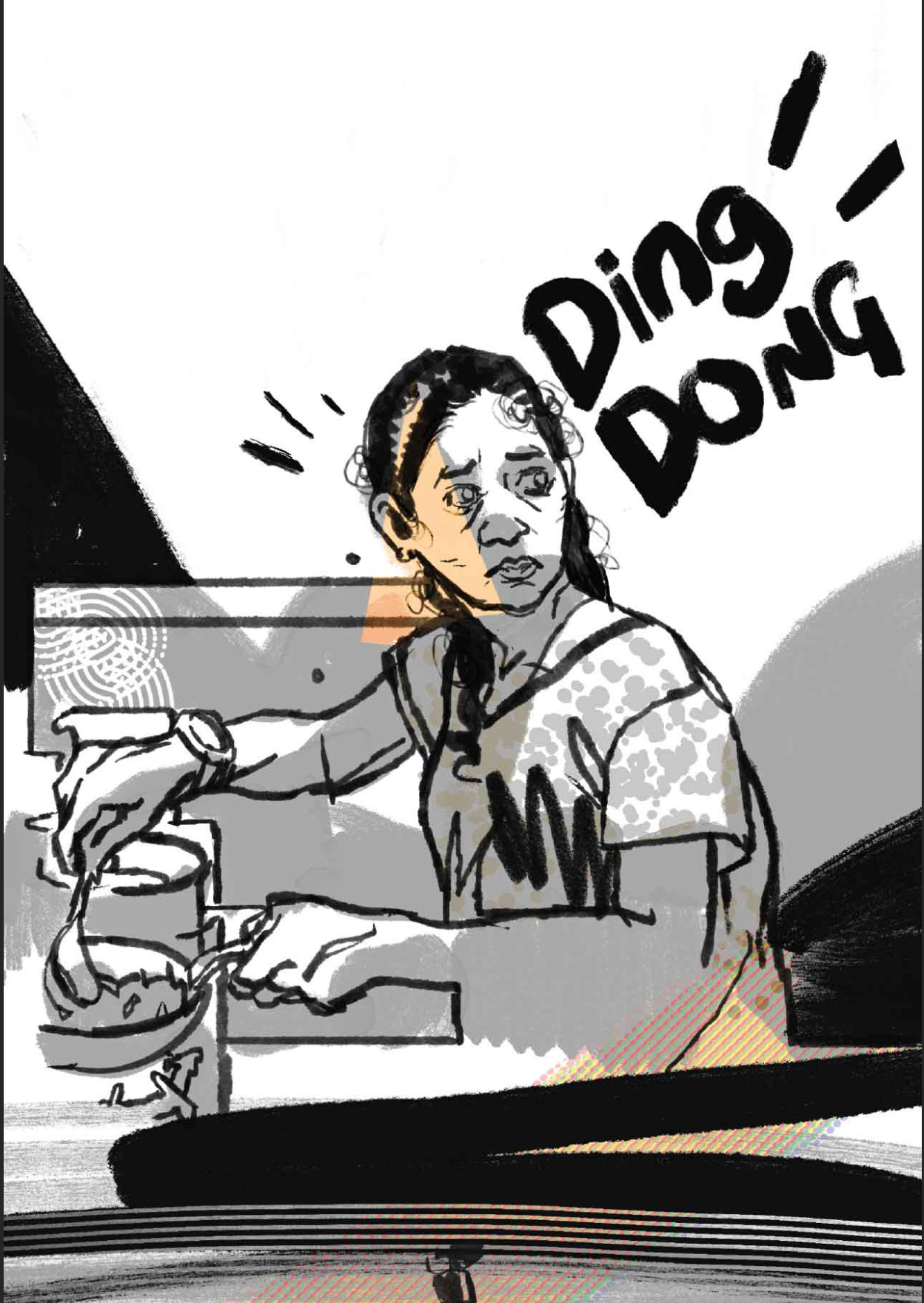
Ruchika Tandon, the neurologist at the center of the piece, has been under “digital custody” for three days. The men on the other end of Skype have taken everything from her: her freedom of movement, her right to speak to her own family, eventually her family’s three-generation nest egg. One of them, who calls himself Inspector Vijay Khanna, has interrogated her for hours, extracted her fears and desires, her strengths and weaknesses. He has made her lie to bank managers, hide under her bed, drive through Lucknow traffic with a phone propped on her dashboard so he can watch her every move.
And then, on day three, he hears that she was supposed to perform at her son’s dance recital, where she was to play the guitar, and he refuses to let her go. He tells her to play the songs at home. She strums through four songs. When she gets to Give Me Some Sunshine, from the 2009 Bollywood film 3 Idiots, his voice cracks through Skype, joining hers. He is, the reporters tell us, absolutely terrible. Way off-key. Ruchika tries not to giggle.
That single, strange, devastating detail: the man who is systematically destroying her life, singing tunelessly alongside her. It tells you everything about the manipulation — the false intimacy, the manufactured bond — and also something genuinely unsettling about the humans on both sides of the scam. It does not explain itself. It does not need to.
This is what Roy Peter Clark, the American writing teacher, means when he says: get the name of the dog. Clark borrowed the formulation from the St. Petersburg Times, where reporters were told they must never come home from a story without knowing the dog’s name.
The name of the dog is not a cute detail. It is a synecdoche — the part that stands for the whole. If a reporter remembers to get the dog’s name, Clark writes, “he or she will be curious enough and attentive enough to gather all the relevant details in their epiphanic particularity.”
In my writing workshops, I use a New Yorker piece by the brilliant Rachel Aviv — “How the Elderly Lose Their Rights” — to make this point. The story is about elderly Americans being stripped of their autonomy by a predatory guardianship system in Nevada. Here is how it opens:
For years, Rudy North woke up at 9 A.M. and read the Las Vegas Review-Journal while eating a piece of toast. Then he read a novel—he liked James Patterson and Clive Cussler—or, if he was feeling more ambitious, Freud. On scraps of paper and legal notepads, he jotted down thoughts sparked by his reading. “Deep below the rational part of our brain is an underground ocean where strange things swim,” he wrote on one notepad. On another, “Life: the longer it cooks, the better it tastes.”
Rennie, his wife of fifty-seven years, was slower to rise. She was recovering from lymphoma and suffered from neuropathy so severe that her legs felt like sausages. Each morning, she spent nearly an hour in the bathroom applying makeup and lotions, the same brands she’d used for forty years. She always emerged wearing pale-pink lipstick. Rudy, who was prone to grandiosity, liked to refer to her as “my amour.”
The piece is replete with detail. The villain of the piece, a court-appointed guardian named April Parks, drives a Pontiac G-6 convertible with a license plate that reads “CRTGRDN.” The husband of one of her victims, a man who reads Freud and Nietzsche and runs for president of the nursing home residents’ council, pines for his “midnight-blue 2010 Chrysler.”
That lipstick. That license plate. That Chrysler. None of these details are explained, because none of them need to be. They accumulate into a portrait of what was taken — not just money and freedom, but the very texture of a life.
Pearson and Sharma work the same way in their Pulitzer-winning story. A farmer named Govind, recruited as an unwitting mule, goes on a pilgrimage to Kedarnath with the man who is exploiting him. The man, Robin, struggles up the 17-kilometer mountain trek on account of his limp, and Govind helps him. Robin buys Govind an amulet — three rudraksha seeds beaded onto a crimson string. They pray to Lord Shiva together. Govind returns home flush with three months’ salary, still wearing the amulet. When he later learns that millions of stolen rupees had coursed through accounts in his name, he is still wearing it.
That amulet does more work than three paragraphs of analysis could.
But there is an important step between “get the name of the dog” and knowing which dog to put in the story. During the reporting stage, you accumulate everything. You ask what the weather was like. What were you wearing? What did you have for breakfast that morning? What is the name of your dog?…
You do not know yet what you are going to need, so you take it all. From my reporting trips, I have notebooks filled with small things — the color of a sun-bleached wall, the make of a motorcycle parked outside and the way one of its rearview mirrors is cracked diagonally (Tell me how you cracked that glass), the way someone holds their tea glass, the man behind the counter at a bakery with a double chin like an upside-down croissant. Most of it will never appear in the story, and that is fine.
I once met a farmer on the fringe of the Rajasthan desert. His head was covered by the traditional, colorful tie-and-dye turban. He was wearing white, as farmers in that region typically do, his clothes stained brown from the fields. His hands were cracked and chipped — a map, I scribbled in my notebook at the time, of decades of hard labour.
At the writing stage, I had to decide what to use. The stained white clothes — probably not. Most farmers in that region wear white; he happened to be wearing white that day, but for all I know he was in something different an hour later. The detail doesn’t carry meaning specific to him. It just describes a category.
But the chapped hands? Those work. They point to the particular years this particular man has worked this particular soil. They are his alone.
This is the thing about writing that nobody tells you clearly enough: writing is editing. The reporting stage is about keeping every door open. The writing is about knowing which doors lead somewhere. The stained clothes are a door that leads back out into the general. The chapped hands are a door that leads further in, toward the specific life of this specific person. Ditch the clothes, keep the hands.
Pearson and Sharma, and Aviv and so many others before them, clearly understand this distinction at a cellular level. Consider what they chose to keep, and what they chose to leave out. We do not know what Ruchika was wearing when she bought the Samsung Galaxy F15 at the electronics store near the metro stop. We do not know what the weather was like in Lucknow on August 1, 2024. What we know is that she had, until that day, clung to an old keypad phone with a cracked screen, not trusting the smartphone world, and that she had to ask the store clerk to help her download Skype. That detail — the woman who distrusted technology, forced by her tormentors to buy the very technology they would use against her — is a door that leads somewhere. The reporters recognized it. They kept it, and they used it with an eye to perfect placement.
Aviv makes the same choices. She could have told us that the Norths had a pleasant home in Sun City Aliante. Instead she tells us that Rudy liked to refer to Rennie as “my amour,” that they took pride in their view of the golf course though neither of them played golf, and that Rennie always emerged from the bathroom wearing pale-pink lipstick. Each detail is load-bearing. Each one earns its place by pointing somewhere the general cannot reach.
But detail alone does not make a great piece of long-form reporting. Detail needs architecture to hold it all together. And this is the second thing I want to talk about: the structure of “India’s Digital Dream, Hacked,” which is, I think, as bold an editorial choice as any detail in it.
The piece has 20 numbered sections and five simultaneous storylines. A neurologist. A farmer. A newlywed who becomes a money launderer. A whistleblower nobody listened to. A slum kid trafficked into a scam center in Cambodia. They never meet. The reporters do not explain, early on, how they connect. Instead, they cut between them, the way a film editor cuts between parallel storylines, and they trust the reader to feel the net tightening. (And because they got telling details, the reader subconsciously realizes that they have worked hard at the reporting, and give the writers their trust.)
Aviv does something structurally similar in the Nevada piece. Rudy and Rennie North are the spine, but around them weave Adolfo Gonzalez, who hides his medications in his cheek. Marlene Homer, who was once a professor and now hides behind pillars. Norbert Wilkening, in the memory ward. Jared Shafer, the “godfather of guardians.” The daughter, Julie Belshe, who is eventually handed a trespassing citation for trying to hug her parents. These characters enter, recede, and return, each one a different angle on the same system.
This is the structural point that often gets missed in discussions about long-form journalism. The choice of how many characters to follow, and when to cut between them, is not a purely logistical decision. It is an argument. When Pearson and Sharma cut from Ruchika transferring her family’s three-generation savings to Rishikesh in a hotel room in Bihar, where Rishikesh watches the money arrive in real time, that juxtaposition is the indictment. They don’t need to say: this is a system that connects a desperate farmer to a corrupt navy man to a newlywed crypto trader to a neurologist hiding under her bed. The structure says it.
The Pulitzer committee cited the piece for coverage that “cast light on the growing global challenges of surveillance and digital scams”. That is accurate but insufficient. What Pearson and Sharma actually did was harder: they built an architecture in which five human lives illuminate a systemic failure from five different angles simultaneously, without losing the thread of any single one. That is not just reporting. That is editing at the highest level — knowing which details carry weight, which characters to follow, where to cut, and when to let a moment breathe.
One detail. One singing, off-key policeman. Everything else follows from the willingness to find it, and the craft to know what to do with it once you have it.
PS: Here is the graphics version of the story.
Is it possible to share details of your workshop if any, upcoming? Would love to attend....
You have said it so brilliantly that observation is the key, "get the name of the dog"
So many lessons in this, Prem. Thank you!
Remember the Rachel Aviv from your workshop. The right details add so much depth and texture to stories.