
Craft Essay #4: You Don't Write Place
On how the best travel writing refuses the aerial view — and why the cup of tea, the beer glass, the man with two names, and the ginger cat do what no landscape description can

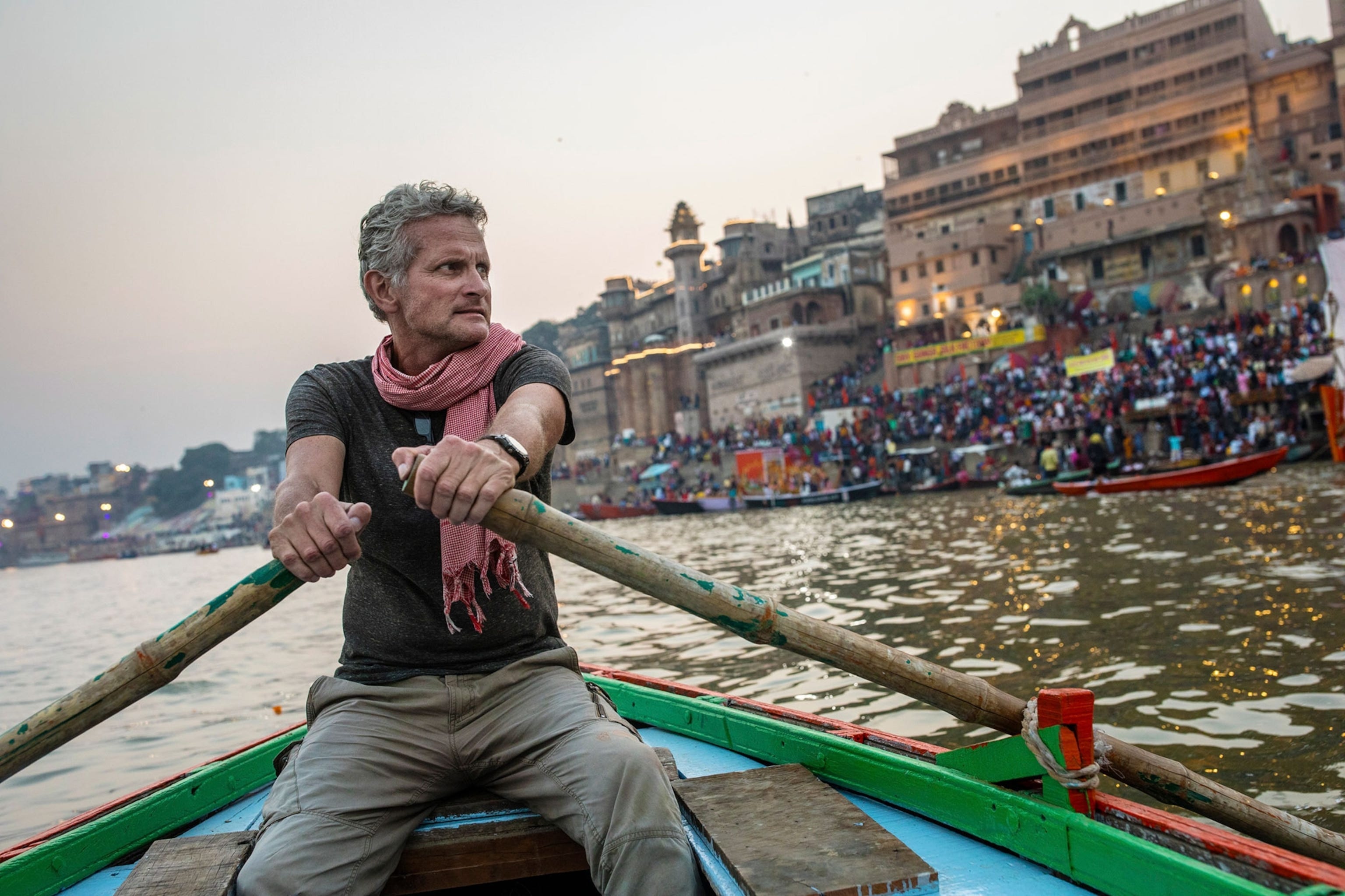
IN THE comments section below the third essay in this series, Rohan Banerjee asked two questions that I’ve been thinking of and which provides the trigger for this essay.
I would love to read about your favourite travel pieces, and why they appeal to you. Specifically, if you’ve considered these two things in travel writing: One, how to avoid the temptation to over-describe impressive landscapes, while still conveying their scale/size. You mentioned exercising restraint when discussing Hiroshima - are there similar examples in travel writing? And two, how to approach describing a place that has been written about extensively and still say something new. The personal angle is the easiest entry point, I guess, but are there other ways to think about achieving this?
These are related questions, as Rohan sensed, but they are not the same question. The first is about restraint, about resisting the temptation to have your writing “live up to the subject”, to match it in scale. The second is about finding the angle, the throughline, when writing about a place that has been written about ad nauseum.
I’ll start with the second question, because I think it contains the answer to the first. And I’ll start with a writer whose work has featured in this series previously.
In January 2020, Washington Post reporter Dan Zak drove across Iowa -- 800 miles, covered in five days. It was a presidential election year, and Zak set out to write about a state that has been written about, multiple times by multiple writers, every four years for at least the last fifty years.
Zak had never been to Iowa before, and this trip was prompted by a long-standing sense of bewilderment. He was puzzling over the primacy Iowa enjoys in the US electoral process. Why do we let these people make a decision that is so crucial?, was the question that animated his reporting trip.
His bent of mind was adversarial; he set out intending to write a takedown, much in the spirit of a 1988 Washington Post piece by his colleague Henry Allen who opened his story on that other key electoral state, New Hampshire, with four words that were his thesis statement:
“New Hampshire is a fraud.”
Allen dismembered the state, taking apart its self-mythology, its smug sense of political superiority, its manufactured mythology of a New England idyll that, as the writer puts it, concealed “souvenir hustlers, backwoods cranks, motorcycle racing fans, out-of-state writers, dour French Canadians and tax-dodging Massachusetts suburbanites.”
Allen did this with his meticulous reporting, and with a voice so pitch-perfect that the resulting piece felt like someone was finally saying what everyone had been thinking.
Zak set out to do the same for Iowa, but his reporting got in the way of his original intent. The myth he had gone to dismantle turned out to be real and, as he delved deep into the soul of the state, he found himself becoming a reluctant believer. And so Zak’s Iowa piece opens not with the takedown, but with a sentence that holds two thoughts simultaneously:
Iowa is a fairy tale. Somewhere between the crumbling bridges, the meth clinics, the jackknifed tractor trailers, the zombie combines steered by satellite, the putrid purgatories for dinner-bound hogs — somewhere among the wannabe novelists and suicidal farmers and drooling cage fighters sponsored by bargain hotel chains, down rutted byways to giant wind turbines, alongside ditches oozing with nitrates and Busch Light — is a loose menagerie of utopia, where Americans are pleasant, responsible and cooperative, where they pass down their civic duty like a trust fund, where they still have one hand in the fallowing topsoil, the other locked in fellowship with their neighbor, and their eyes on the future of the republic.
During his reporting, Zak found both darkness and idealism, and so he opened with a sentence that branched to the left and right of the central subject — “a loose menagerie of utopia” — piling darkness and decay on the left, and idealism and hope on the right. Allen’s New Hampshire is a fraud, period. Zak’s Iowa is simultaneously a fraud and a fairy tale, and the reporter does not choose a side, a point of view, but lets both co-exist because in the place he is writing about, both are true.
Zak’s breakthrough, and the true power of the piece, comes not from finding new facts about Iowa but from being willing to allow contradictory truths to coexist. He found something new to say about a place written about so many times because he went in with an honest question — why do these people get to decide? — and followed it to an honest answer.
The short answer: A new relationship to the place produced the new writing about it.
Which brings me to a writer whose works have been, for me, go-to textbooks on the art and craft of writing. Or to be more accurate, Arati Kumar-Rao put me in mind of him during a recent chat on craft: John Steinbeck, and a street in Monterey, California, that has been mythologized, romanticized, long before Steinbeck got there. This is how Steinbeck opens Cannery Row:
Cannery Row in Monterey in California is a poem, a stink, a grating noise, a quality of light, a tone, a habit, a nostalgia, a dream. Cannery Row is the gathered and the scattered, tin and iron and rust and splintered wood, chipped pavement and weedy lots and junk heaps, sardine canneries of corrugated iron, honky tonks, restaurants and whore houses, and little crowded groceries, and laboratories and flophouses...
Re-read that first sentence. Steinbeck uses nine nouns, none of them descriptive in the conventional sense of the word. He writes the place, and we perceive it, as sensation, as mood, as memory, strung together in a list that accumulates sensations without explaining any of them, or rendering a verdict.
Steinbeck doesn’t tell you what Cannery Row looks like, which is what a lot of travel writing tries to do. Instead, he tells you what it is, and what it is turns out to be many contradictory things at once, and it is that very contradiction that makes the place real. He doesn’t argue, as Allen does. He doesn’t try to balance the dark and the light, as Zak does. Instead, Steinbeck lists, and trusts the list to do the work.
Three writers writing about three over-written places, and each of them picks a different formal strategy. What they share, and this is the crux of Rohan’s question, is that none of them try to find something new about the place itself; instead, what they do is find a new relationship -- Allen’s antagonism, Zak’s reluctant conversion, Steinbeck’s refusal to explain. And these new relationships drive the writing.

CALL it the frequency illusion or the Baader-Meinhof phenomenon at work, but the same weekend that surfaced Rohan’s question brought me a piece about a city that has been extensively written about — Hanoi, with its libraries-worth of war literature, its Graham Greenes, its Frances Fitzgeralds, its complex pastiche comprised of Western project and its own self-mythologizing.
Writer and design researcher Parni Ray found her Hanoi not through history, not through the overly familiar set piece scenes of the Old Quarter or the Hoan Kiem Lake. Rather, she found her way into the story through a beer glass.
Specifically, Ray’s entry point was through the Bia hơi cốc, a handmade, blue-green beer tumbler used to serve fresh draft lager since the subsidy era of the 1970s. The glasses are cheap, irregular, with imperfections that are unique to each glass, and it costs the equivalent of twenty cents to fill.
Ray used the glass to produce one of the most inventive examples of place writing I have read in years — one that, ironically, does not ‘describe’ Hanoi in any conventional sense.
Ray follows the glass, and through that journey she introduces characters, scenes. Retired officials drinking blood-cut Bia hơi at the Ba Đình Sports Center. The glassblowing workshops of Xôi Trì village, where families make the cốc by hand from recycled glass in furnaces that reach 1,800 degrees Celsius. Le Huy Van, the 82-year-old former rector of the Hanoi University of Industrial Fine Arts, who sketched the prototype. The craft beer bars that have adopted it, the French designers who alchemized its imperfections into selling points, and the export market that has transformed flaws into assets.
The glass is the lens through which Ray explores, and tells us about, colonialism, about the subsidy era and the ration tickets that made a standard glass necessary; about a French brewery that became a national institution; about Đổi Mới and about the market reforms that dissolved the queues; about the rise of Chinese mass production and the one thing it has not been able to replicate.
She explores the tension between craft preservation and economic survival, and the question of what happens to an object designed for the working class when it gets a cachet in the design world and is sold abroad for thirty-six Euros.
Ray does not state any of these as her theme — they all arrive through the glass.
When the old men at the Ba Đình Sports Center are asked why they don’t drink other things from the cốc, one of them says:
The cốc is the beer. The beer the cốc.
And in that same spirit Le Huy Van, the original designer, responds to a question about whether he minds what his creation has morphed into:
The cốc no longer belongs to me. It belongs to the people.
Those lines contain the whole essay, and the essay contains a Hanoi that has been written about excessively, but never seen in quite this way. And those lines acquire weight because Ray has followed the glass through its making, its distribution, use, adaptation, and even its potential obsolescence.
This is the second answer to Rohan’s question. You find an object the place has made, one that is unique to the place, one that only this place could have made at a particular time and in a specific set of circumstances, and then you follow it wherever it leads.
The place will come with it.
THEY say the right teacher comes along only when you are ready to learn. For me, that moment came in 2018, by when I had worked in three print papers as feature writer and Features Editor, then 16 years in Rediff (including five in New York), then another four running Yahoo India’s media operation. I had more to learn and didn’t even know it — and at that point in my life, along came Paul Salopek, who has been walking the world since 2013 and retracing, on foot, the route our ancestors took when they first began migrating out of Africa some 60,000 years ago.
In 2019 he entered India from Pakistan, and by the time he walked 2,400 miles across the northern half of India in roughly 17 months, he had by example shown those of us who were fortunate to walk with him a way of writing place that is unlike anyone else’s.
His method is deceptive in its simplicity: he enters almost every place through a human being. Not through history, though history is the underlying underlying throughline. Not through the large geographical or political themes, though he is deeply immersed in both. Instead, he finds a person whose life is being lived inside the large landscape, and he writes about that person, that life. And as he writes, the place comes to life around that person, the way a river will assemble itself around its banks.
Another method Paul defaults to is to use an object as his entry point, in a way somewhat akin to Parni Ray. For instance, read a dispatch he filed from Gwalior. He had walked hundreds of miles to witness something most of us would walk past without noticing: two small zeros, carved onto a stone slab in a 1,200 year old temple.
It is among the oldest recorded zeroes and the piece is, quite appropriately, titled ‘Walking to Zero’. When Arati and I met him at the Wagah border, he had told us about this goal. He walked the wheat fields of Punjab, scaled the dunes of Rajasthan, slithered down the red stone gullies of Madhya Pradesh and finally arrived at the temple in the company of a former student.
They peered through a locked grille at the famous slab of stone. They couldn’t see the zeros. Neither, it turns out, could anyone else — despite the sign that reads: ‘ZERO: The Oldest Existing Zero in Gwalior Region’. Paul’s summary graf is a classic:
My pilgrimage that began with nothing ends with nothing. It has been for naught.
That one sentence is both joke and insight. He had walked 950 miles towards a symbol of nothingness, and had finally arrived at nothing. He didn’t need to explain — he just walked it, then wrote it down, and it is there for the reader to make of it what she will.
In Bodh Gaya, the birthplace of Buddhism, he walks to the sacred Bodhi Tree — surrounded by a wall, bombed by Islamic extremists in 2013, now guarded by police — and notices, in the same sentence, the Be Happy Café three blocks away and a middle-aged Krishna devotee from Iowa named James, who works in a used bookshop nearby. He doesn’t explain the irony, but lets the juxtaposition become its own judgment.
He walks in the footsteps of the Buddha in the company of Deepak Anand, a self-taught cultural geographer who has spent twelve years using GPS technology to chart the pathways the Buddha probably walked 2,400 years ago. Anand is tall, pin-thin, with a shaved-headed, and so intense that he orders tea and forgets to drink it.
Paul walks at a punishing pace, as I know from experience, covering 35-40 km a day even as he observes, and writes, in the moment, but Anand walks even faster, surging ahead on the trail and occasionally pausing to call back: “Sorry, sorry, sorry. I’m a high-energy person.”
Anand is Paul’s entry point and through him — his obsession, his frustration with the pilgrimage mafia and with rival Buddhist sects who won’t accept his GPS coordinates for the site of the Buddha’s enlightenment — Paul gives us the entire story of how Buddhism ghosted from its Indian source, and what it would take to bring it back.
He ends the piece at a bus stop in Bihar. Anand asks for endurance-walking advice before they part. Salopek writes:
I’d forgotten to tell him that, on any long walk, he will get lost. And that being a little lost isn’t bad. It helps you stay awake. And being found is overrated.
That is philosophy wearing the outer garb of travel writing, and it arrives through the specific — a man who forgot to drink his tea, asking for advice at a bus stop in one of India’s poorest states. And that is writing about Bodh Gaya, and of the Buddha’s birthplace, in a way different from all previous writings on a much-written-about subject.
Paul writes of the Ganges through Mahendra Mandal, who he finds in his tomato field, waiting sixteen years for his land to come back from under the river. And through Mandal, Paul explores, then dismantles, one of the most comforting “truths” we think we know about rivers — that they move in one direction. No single line, Paul finds, can define the Ganges. Over years, the river yaws crazily sideways, in some cases for miles. The Ganges draws circles through time, as blind as the freshwater dolphins that breach its surface.
His dispatch from the Brahmaputra ends with a question the people who live on the chars ask — where are you going? — and his answer is also a statement of his method:
You smile. You don’t break stride. You say I don’t know I don’t know I don’t know stop asking.
This is the Out of Eden Walk’s core discipline: to move through a place without a fixed destination, to walk at the speed the place demands, and to notice what reveals itself to someone who is moving slowly enough to see it.
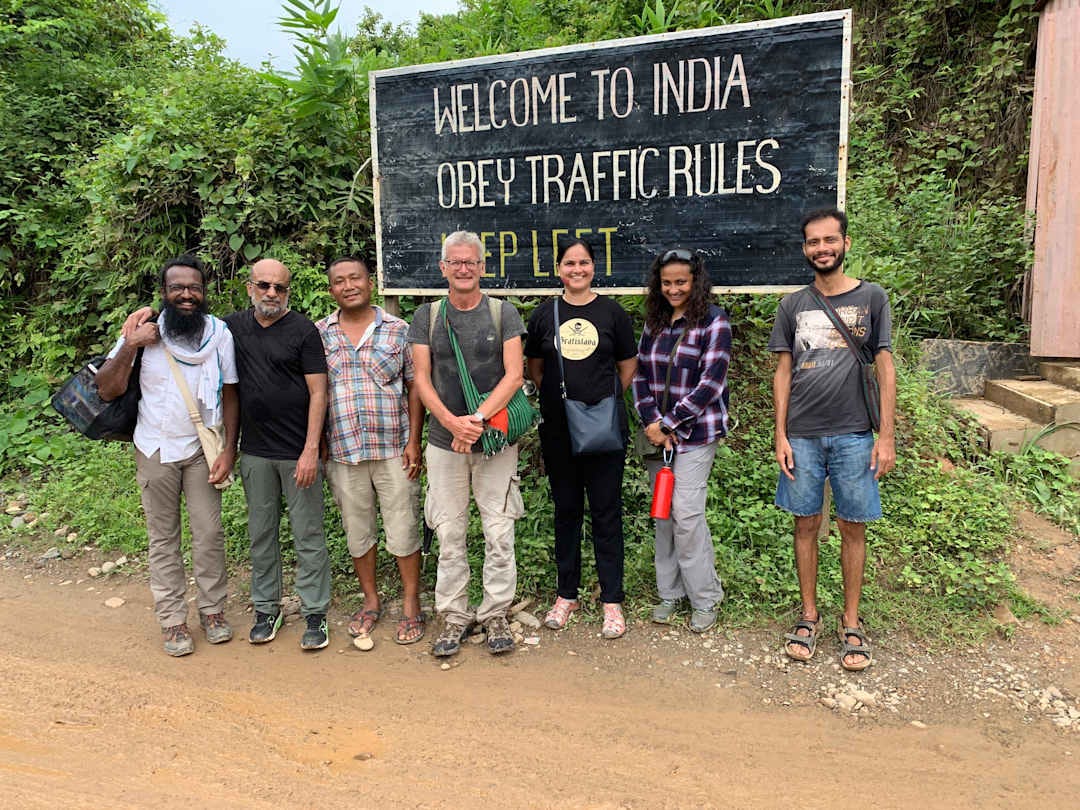
I learned, while walking with Paul, that the fact of walking brings its own restraint. You cannot over-describe a landscape through which you are moving at walking pace because the landscape keeps changing, it keeps offering you one thing and then another particular thing. The 30,000 feet view — the grand sweep of history, the sweeping geographical statement — is not consonant with someone whose feet are on the ground.
I learned this through walking with Paul. In the summer of 2018, in peak desert heat, I walked a segment of the Out of Eden Walk. What it taught me was a way of paying attention. I noticed the landscape as landscape, yes, but unlike in the past, I learned to see landscapes through a series of encounters: the elderly patriarch on an antique bicycle who appeared when I needed shelter, the Tandi family who fed us from a brass plate so enormous it took two people to carry it, the matriarch and her retinue, dressed in their best, who walked a mile in the pre-dawn dark to bring us flasks of tea sweetened with jaggery before we set out.
When you are in remote landscapes, and your day’s walk begins at five in the morning, you don’t have the luxury of room service bringing you hot tea to sustain you. It was that cup of tea the Tandi women brought us — the only time in the entire walk that I remember someone bringing us such sustenance — that moved me, that made me tear up. Not the desert, not the dunes, not the scale of the landscape stretching to the horizon in every direction. A cup of tea, handed to us by women who had risen before dawn to make it. (Scroll down to find this story)
That is what walking teaches you to write: not the view, but the cup of tea and the women who care enough to make it and bring it to you. And that story tells you of a place in a way that not all the travelogues can.
(Nine walking partners, including me, wrote of the walk the way they experienced it. The pieces, including mine, are here. Arati Kumar-Rao’s piece on searching for the endangered dolphin in Harike leads the list; contrast that with Paul’s take on the same subject here. And all of Paul’s dispatches from India are here.)
WHERE Paul Salopek’s entry point for a travel piece is through humans who inhabit landscapes, Arati Kumar-Rao braids the land and the human, and lets the story determine which of the two should carry more weight.
In her Sundarbans dispatches, the natural world dominates — the pneumatophores breathing through the mud flats, the Irrawaddy dolphins struggling to exist, the tiger swimming a channel. Because in those dispatches the story she sets out to explore is that of an ecosystem under threat — and humans live inside that threat, and not apart from it.
In her desert journal from the Out of Eden Walk, though, human encounters dominate. She writes of Brijlal, sheltering under a khejri tree from the stifling desert heat, philosophizing that the one who made man made all men equal. The priest, with the Godfather voice and the stoned eyes. She writes of humans because during that segment of the walk, what she observed was the ways in which humans endured in extreme landscapes.
Different methods, but a shared refusal to take the 30,000 feet view, and a shared commitment to moving at the speed of the human body. Both writers trust their instinct that the large things will arrive through the small ones.
This is the discipline that answers Rohan’s first question: how do you convey scale without matching it? The short answer is, by not trying to match it. Instead, you find the human life that the scale is moving through and you write that life. When you do that, scale is the consequence of the story, not the story itself.
Tangentially, I have lost count of the number of times Arati, in various shades of exasperation, has told me ‘You don’t just see a landscape, Prem, you absorb it with ALL your senses.’
A teachable example comes from the Rajasthan leg of the walk, where Arati and I accompanied Paul. All of us noticed the same thing, but it took Arati to produce a piece that demonstrates how to use a sense, other than the eye, to undergird a landscape story.
Arati uses her ear, her sense of sound, in this piece, and it is worth reading and saving as a craft lesson.
Silence, for me, is neither an absence of sound, nor is it uniform. The silences of the river are different from the silences of a desert. Yet both are vast, and they are full of surprises.
IN THE northeastern corner of India, the Tsangpo river makes a hairpin bend from Tibet and reappears as the Siang. There lies a forested gorge that Tibetan Buddhists have, for centuries, venerated as one of their holiest lands.
Pemakö is the indestructible beyul that Guru Padmasambhava created in the eighth century as a concealed shelter for those fleeing persecution. It is also, the belief runs, the geographical manifestation of the sow-headed Goddess of Wisdom. And it is among the most written-about sacred landscapes in the Himalayas. Botanists, Buddhist pilgrims and geographers have all attempted to capture it in words.
Arati Kumar-Rao went there in the cusp of spring with a guide, Katon, to walk the kora — the clockwise circumambulation — around the holy mountain of Devakota.
She could have written of the ancient tree ferns that predate dinosaurs. Of the silk-cotton trees exploding red with inflorescence. Of the Yang Sang Chu, the Secret River, so far below in the gorge that you only occasionally glimpse it as a rush of rapids that disappears under an overhang. Of the sacred mountain where three holy peaks concentrate their energies, where meditating one day, they say, is equal to meditating for a year anywhere else on earth.
She writes all of this, as have so many others. But what the piece is really about arrives in a detail so quiet that it almost slips past without you noticing. As Katon and Arati move deep into lower Pemakö, crossing an invisible but very real cultural border, something changes. Katon introduces himself to the Adi people of the Siang valley as Pema -- his Khamba name, which he uses when he visits the region that holds the other half of his identity.
On one side of the border, he is Katon. On the other, he is Pema. Same man, two names, two different relationships to the same landscape.
That detail, of the man whose identity shifts as the terrain shifts, contains the whole essay. It tells you more about the layered histories and cultures that have shaped this hidden land than any description of the gorge could.
And then there is the kora itself, the climb up Devakota in the rain, along a path that nudges along narrow ledges that drop vertiginously into the Yang Sang Chu gorge. Arati’s feet slipping and sliding on wet rock. Clothes sodden. A profusion of black flies whose anticoagulating bite keeps the blood flowing freely from every exposed inch of skin.
None of this is complained about; all of it is simply reported with the precision of someone paying close attention to what her body is moving through.
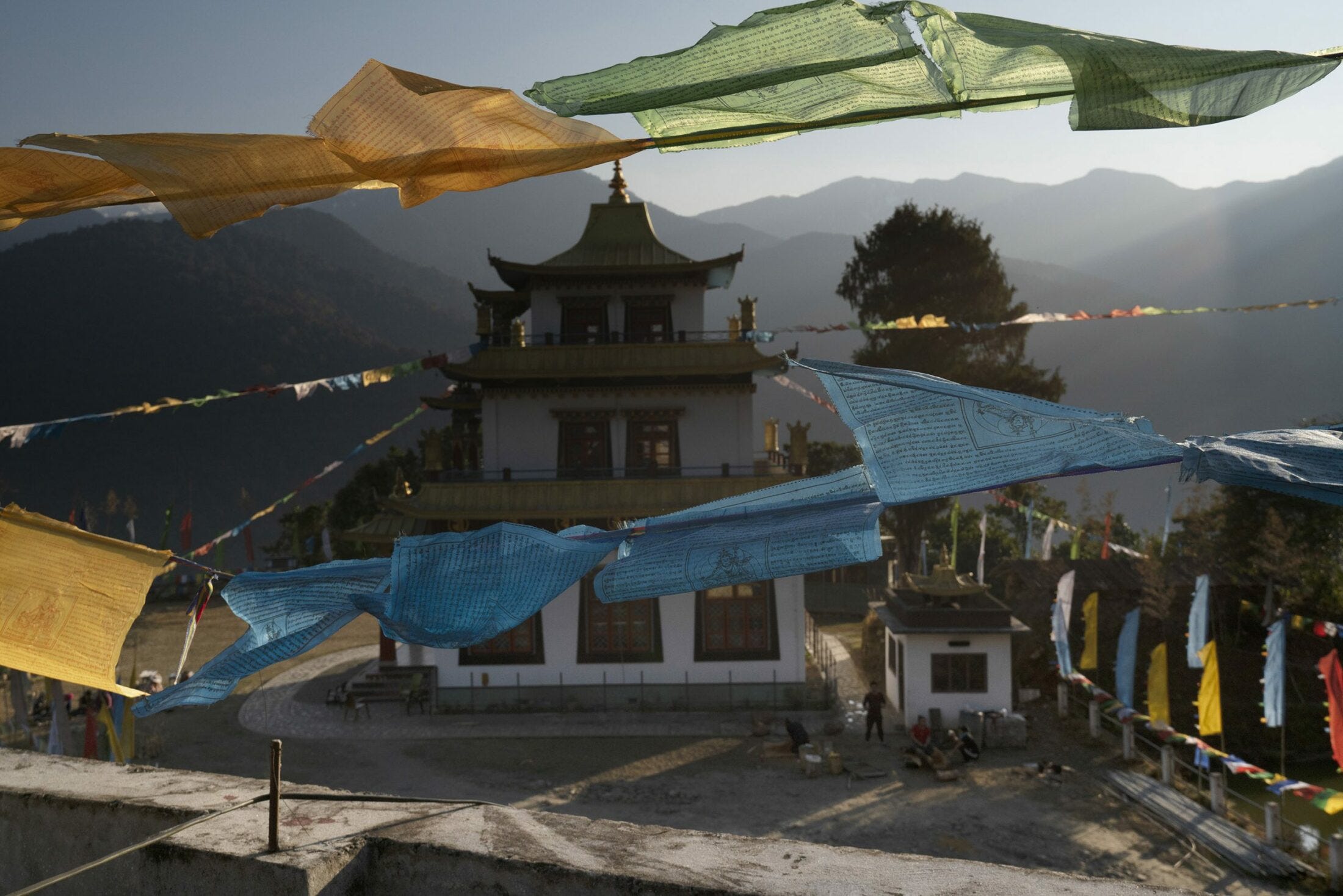
At the top of the mountain, inside the tiny monastery, something breaks open deep inside her. She prostrates before the golden statue of Guru Rinpoche, raises her hands, asks for blessings. And then, unaccountably, the tears come.
I weep, my breath coming in sharp, short intakes that echo around the walls of the monastery. A lama seated under the gong stops chanting momentarily to look at me. My knees give way; I sink down to the floor and lean against a carved, painted, ornate pillar. A ginger cat that enthusiastically welcomed us at the top of the mountain crawls into my lap and licks my face.
That ginger cat, seen through sudden tears, in a monastery at the top of a sacred mountain in one of the most venerated hidden lands in the Buddhist world, after a climb through rain and black flies and slipping feet and narrow ledges above a gorge. That ginger cat that crawls into her lap and licks her face...
Arati does not explain what the cat means. She does not explain her tears. She trusts that everything that preceded them —weeks of research, half a day of bumping along a rocky road, the climb, the kora — has earned them, and she trusts the cat to do what the cat does, which is to arrive at precisely the right moment and be exactly itself.
This is restraint in the face of scale at its most demanding, because Pemakö is not just a landscape. It is simultaneously the body of a goddess, a promised land for the persecuted, a biodiversity hotspot, and a geopolitical flashpoint — China is planning a hydropower dam upstream, and India is building a highway that is gnawing into the sacred confluence below.
The temptation to write at that scale, to reach for language equal to that magnitude, must have been enormous. Instead, she writes of a man with two names, of tears that come without preamble, and of a ginger cat.
This is what Rohan asked — how do you convey scale without matching it? The answer is, you don’t even try to. Instead, you find the detail that the scale is moving through, and you write the detail, allowing the scale to arrive as consequence.
THIS response is both complete, and not.
Rohan asked, at the start of his comment, for my favorite travel pieces. I haven’t answered that question, and I am not going to answer it now.
That is not because the question isn’t worth answering. But a list of names, without the reasons for why each choice is made, is just a list — it tells you what I love but not the why, and the ‘why’ is the only part that is useful in a craft essay.
I have an extensive collection of favorite pieces, and books, and the ones linked above are part of that collection — but I used these specific stories not as a “list of favorites”, not even my only favorites, but as testimonies to specific principles of writing, as articles that demonstrate what travel writing does when it is working at its best.
Zak and Allen testify to this: that you don’t write about an over-written place by looking for something new to say about it. Instead, you look into your own relationship with the place — antagonism (Allen), reluctant conversion (Zak) — and the writing follows from that.
Parni Ray testifies to this: that an object the place has made, no matter how cheap, can carry the whole of a city’s history, its economics, and its social life, if you follow it far enough.
Salopek testifies to this: one way to write a landscape is to find the human life that the landscape is moving through. In such writing, the river is not the subject; the subject is the person whose fate is entangled with the river, and that the river, the place, arrives as consequence.
Arati testifies to this: that restraint when confronted with scale is not an absence of feeling, or of writing ability, but rather its most precise expression. The ginger cat and the man with two names do more than pages of florid description can because they are irreducibly themselves — specifics arrived at through a body moving slowly through impossibly difficult terrain.
And all of them, together, testify to the same thing: you don’t write place. Rather, you write what you noticed, absorbed through all your senses, with the sensibility you brought to that specific landscape on that specific day. You accumulate the details that you observed, and you let the entirety of the place assemble itself around this accumulation.
That is the only useful answer I have in response to Rohan’s questions. It is not about some formula but rather, a discipline we need to reinvent every time we find ourselves in a place that we love, or hate, or don’t quite understand.
This is perhaps why the best travel writing feels less like a description of a place and more like an encounter between the writer and the place, on the day they were there.
PostScript: Standard essays on travel writing reduce themselves to bullet-pointed advice:
use detail,
avoid purple prose
focus on people
find fresh angles
This is not a how-to essay but rather, an attempt to articulate how I think about writing place.
Rohan also asked about favorite travel writing, the question I left unanswered because no essay can contain all the writers who shaped my sense of place. I’ll end this, though, with a list of a few books and authors who have, over the years, helped my understanding of the craft (in no particular order):
Evan Osnos’s Age of Ambition for how it captures modern China through individual lives and emerging contradictions; Pico Iyer’s Video Nights in Kathmandu for its searching intelligence about Asia and its cultural collisions; V.S. Naipaul’s India: A Wounded Civilization and The Middle Passage for the deeply subjective gaze; Ryszard Kapuściński’s Imperium for how the vastness of empire dissolves into human detail; Jan Morris’s Trieste and the Meaning of Nowhere for how to write place as both identity and layered memory; Bruce Chatwin’s In Patagonia for its fragmentary form; Rebecca Solnit’s Wanderlust for walking as a way of knowing; William Dalrymple’s City of Djinns for how a city’s past and present can co-exist in the same paragraph; Robert Macfarlane’s Underland for showing me how landscape writing can traverse geology, myth, memory and politics while grounding itself firmly in the tactile, the walked-through; and Peter Matthiessen’s The Snow Leopard, fow how the journey through the Himalayas remains inseparable from the inward journey. And that is only a partial list.
An unexpected joy of writing these essays is the rich comments section below each. Keep the conversations going, please. Also, suggest your own favorites, things I should be reading, and your own experiences with travel writing.
I went down some of the rabbit holes and came up with this.
"Come for the other India. The one that despite the best efforts of the bigoted, lives on with a welcoming smile. In the proffer of a cup of tea that will warm you inside and out. "
Thank you.
Thanks for exposing us to a variety of travel writers.Reading your articles on writing, it feels lke we are attending a writing course free of cost and learning much.
I was reminded of the Malayalam writer SK Pottekkat, one of the earliest travel writers in India,whose African sojourns were well read.His writings were rich with the geography and history of the places he visited and how he arrived at them. It was information and travel experience woven together.
However in the digital age we live in, travel writing has to have a different sensibility, that which cannot be had at the click of a button, less of information and more of human interaction.